ITEMIZED BILL
How do I get an itemized hospital bill?
Call the billing number on your statement (or use the patient portal) and ask for an itemized bill — sometimes called an itemized statement — for your account and dates of service. It lists every charge separately, usually with its date, a code, a description and the quantity, which a summary bill doesn’t; HHS says billing records are part of the health information you have a right to access.
Why it’s confusing
Hospitals usually send a summary first: a total and a few category lines such as “pharmacy” or “room and board”. You can’t tell from that whether anything is duplicated or missing.
Itemized bills are long and full of internal abbreviations and codes, so people ask for one and then can’t use it. Knowing what to look for makes it worth the call.
How to read it
Ask for the right thing: an itemized statement with CPT/HCPCS codes, revenue codes, dates and quantities, for all dates of service. Ask whether the insurer’s payments and adjustments are shown on it.
Check the basics first: your name and insurance details, the admission and discharge dates, and the number of room days.
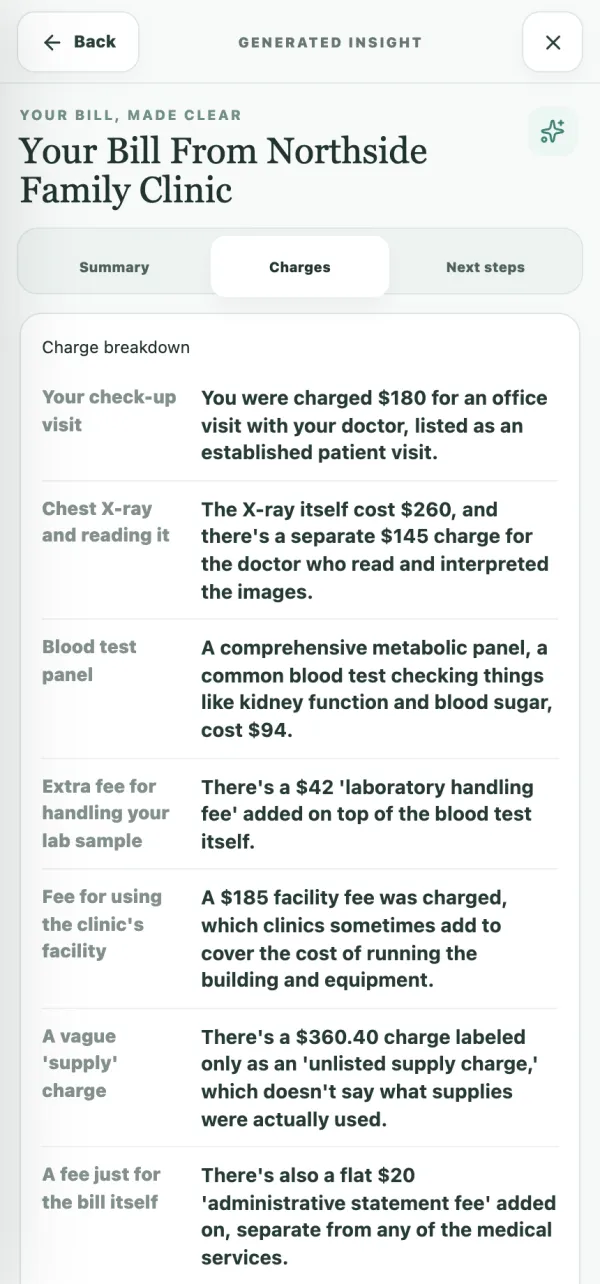
Then scan for repeats (the same code twice on the same date), large quantities, services you don’t recognise and supply lines with no detail. Each is a fair question — not proof of a mistake.
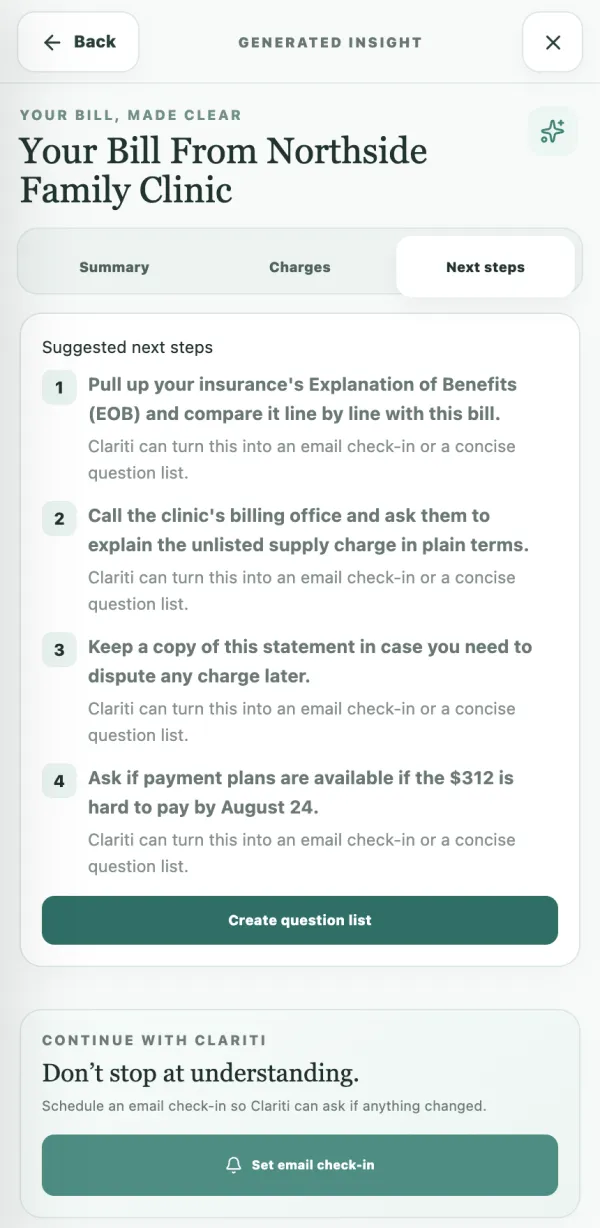
Compare the totals with your EOB. The EOB shows what the plan allowed and what is left for you; the itemized bill should agree with it once payments are applied.
| On the document | Shows | In plain language |
|---|---|---|
| 0250 Pharmacy | J2405 × 2 | Two units of a drug given in hospital, billed with a HCPCS drug code. |
| 0300 Laboratory | 85025 × 1 | A complete blood count — one test. |
| 0300 Laboratory | 85025 × 1 (same date) | The same test again that day — worth asking if it was really done twice. |
| 0270 Supplies | No code, $212.00 | A supply charge with no detail — ask what it covers. |
The four-digit numbers are revenue codes (the hospital department); the five-character ones say what was done.
What it does not mean
- That asking for one will annoy the hospital. It is a routine request.
- That every unfamiliar line is an error. Many are normal — the point is that you can now ask.
- That you must pay before you get it. Ask for the itemized bill before paying a large balance.
Where you’ll see it
- Requested from hospital or clinic billing departments, or downloaded from a patient portal.
- Sometimes sent automatically when a bill goes to a payment plan or collections.
Questions worth asking
Ask the billing office
- Can you send an itemized statement with codes and quantities for all my dates of service?
- Does it show my insurer’s payments and adjustments?
- Can you hold the account while I review it?
Common questions
- Is an itemized bill free?
- Billing offices normally send itemized statements on request without charge. If you ask under your HIPAA right of access, HHS limits any fee to a reasonable, cost-based amount.
- How long does it take to get an itemized bill?
- Often a few days to a couple of weeks. Ask for the account to be placed on hold until you have it.
- What is the difference between an itemized bill and a summary bill?
- A summary bill shows totals by category. An itemized bill lists every individual charge with its date, code, description and quantity.